Horizontal Gene Transfer
By transferring genes from other organisms, scientists create genetically modified crop plants and animals. For example, genes from bacteria are inserted into corn plants in order to make the latter resistant to diseases, pests, and herbicides. Opponents of genetically modified crops and animals often complain that moving genes between species is unnatural. Leaving aside the fact that the whole of agriculture is unnatural, this is still an odd worry. It has been known for a while that some genes move from one species to another given the chance, in a process called horizontal gene transfer. Genes for antibiotic resistance, for example, swap freely between species of bacteria. Only recently has it become clear just how widespread such natural transgenics is. What was once regarded as a peculiarity of lesser organisms has now been found to be true in human beings, too.
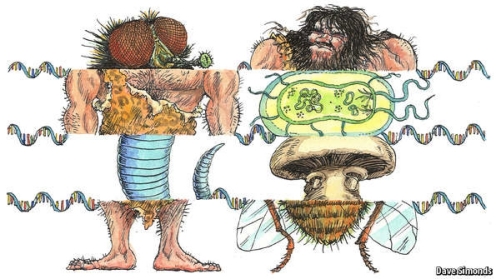
Alastair Crisp and Chiara Boschetti of Cambridge University, and their colleagues, have been investigating the matter. Their results, published in Genome Biology, suggest human beings have at least 145 genes picked up from other species by their forebears. Admittedly, that is less than 1% of the 20,000 or so humans have in total. But it might surprise many people that they are even to a small degree part bacterium, part fungus and part alga. Dr. Crisp and Dr. Boschetti came to this conclusion by looking at the ever-growing public databases of genetic information now available. They did not study humans alone. They looked at nine other primate species, and also 12 types of fruit fly and four nematode worms. Flies and worms are among geneticists’ favourite animals, so lots of data have been collected on them. The results from all three groups suggest natural transgenics is ubiquitous. On average, worms had 173 horizontally transferred genes, flies had 40 and primates had 109. Humans thus had more than the primate mean.
Useful immigrants
The role of many of the foreign genes remains obscure. But some human transgenes are surprisingly familiar. The ABO antigen system, which defines basic blood groups for transfusion purposes, looks bacterial. The fat-mass and obesity-associated gene seems to come from marine algae. And a group of genes involved in the synthesis of hyaluronic acid originates from fungi. Hyaluronic acid is a chemical that is an important part of the glue which holds cells together. Altogether, the researchers found two imported genes for amino-acid metabolism, 13 for fat metabolism and 15 which are involved in the post-manufacture modification of large molecules. They also identified five immigrants that generate antioxidants and seven that are part of the immune system.
This is quite a catalogue. If plant or
animal breeders insert genes from other organisms into crop
plants or cattle, there would no doubt be an outcry. In
humans, however, foreign genes are doing a good job. It is
fair to point out that many of them seem to have been
cohabiting with the line that led to humanity for millions
of years, and both sides have thus had ample time to adjust.
Nevertheless, there was once a moment for all of them when
they were just as alien as a bacterial insecticide is in a
maize plant, or a herbicide-resistance gene is in a soya
bean.
538 words
Adapted from: The Economist, March 15, 2015
From the print edition: Science and technology